Friday, October 8, 2010

Royal Jelly!

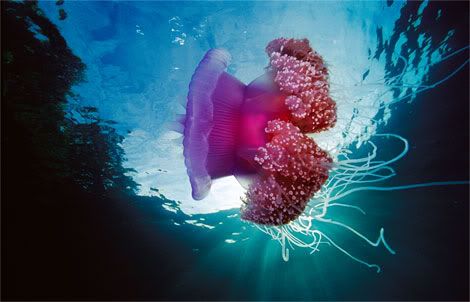
Crown Jellyfish
    These jellies might just be the Royal jellies of the sea, I mean with a name like Crown Jellyfish how can you go wrong? 
The eye spots can be seen around the cap of the jellyfish while the whitish "dots" around the base are actually tentacles that are withdrawn. Jellyfish have a very advanced water vascular system that allows them to pump water in and out of their bodies thus pushing out or pulling in their tentacles.


The stinging cells or nematocysts are microscopic spring loaded darts found on the tentacles and are extremely sensitive to pressure. When touched, thousands can be discharged. This is the mechanism that normally allows them to capture their prey, ranging in size from microscopic plankton to small fish. Numerous mouths are found underneath the central frill of the jellyfish.


 The crown jellyfish is found at depths below 900m (3000 ft), where the water temperature is really cold. Also, the Crown jellyfish undergoes straight up and down movement from deep water in the daytime to shallow water at night in order to follow their prey, or catch their prey. 
crown Jellyfish are mostly found at mesopelagic depths (between 200m and 1000m, called the twilight zone) in all oceans worldwide, but mostly in the Pacific Ocean and Atlantic ocean. 


Unfortunately, this is all of the information that I could find on them so I really can't tell you if they are poisonous to humans( but they probably are!).

King of the Big Blue Sea

Blue Whale
So I have to say that one of my favorite animals in the world is a Blue Whale.  They are just AMAZING!
The blue whale is the largest mammal, possibly the largest animal, to ever inhabit the earth. The longest blue whale ever recorded was a 108-foot adult female caught during whaling efforts in Antarctica! In modern times, blue whales in the Southern Hemisphere reach lengths of 90-100 feet, but their Northern Hemisphere counterparts are smaller, on average 75 to 80 feet. Blue whales can weigh over 100 tons. Females are larger than males of the same age, the largest perhaps weighing as much as 150 tons.


The blue whale is thought to feed almost exclusively on small, shrimp-like creatures called euphausiids or krill. During the summer feeding season the blue whale gorges itself, consuming an astounding 4 tons (3.6 metric tons) or more each day. This means it may eat up to 40 million krill a day Blue whales may be found in all oceans of the world.
They migrate to tropical-to-temperate waters during winter months to mate and give birth to calves. They can feed throughout their range, in polar, temperate, or even tropical waters.

Puff, Puff, Blow Fish.

Puffer not inflated
The puffer fish (also known as the blowfish and the toadfish) is a medium-sized species of fish that inhabits warmer, coastal waters around the world. The puffer fish is most well known for it's unique and distinctive adaptations that the puffer fish has to defend itself.There are around 120 known species of puffer fish, the second most poisonous creature on the planet after the Golden Poison Frog. The puffer fish is found in tropical waters worldwide, but they rarely go into the cooler waters.The puffer fish has the remarkable ability to expand its body extremely quickly when faced with danger, unavailing it's long poisonous spikes that cover its body. If a fisherman catches a puffer fish, they will never touch the spikes as they are highly toxic to humans and animals.


Man holding a Puffer
 The puffer fish can grow to up to 60cm in length but the exact length of the puffer fish depends on the species of puffer fish. Puffer fish can be found in a variety of colours but can sometimes be hard to identify when they are not inflated. The puffer fish normally has the appearance of a large tadpole, with bulging eyes and an elongated snout
Puffer fish are omnivorous animals and eat a variety and plants and animals. Puffer fish mainly feed on the algae that grows on the rocks and coral and also the invertebrates that inhabit these areas. Large species of puffer fish will also eat shellfish such as shrimp and crabs and mollascs.
Although there are a number of animals that prey on the puffer fish, these predators often meet with a nasty end. When the puffer fish is threatened it inflates it's body with air exposing the long, sharp, toxic spikes which normally intimidates the predator into retreating. If however, an animal does manage to eat the puffer fish, it will often be poisoned by the toxins in the spikes or the toxin that is released from the organs of the puffer fish when it dies.

Despite the toxins in the puffer fish, some animals such as sharks are able to eat the puffer fish without becoming harmed. It is important also to know that not all species of puffer fish are actually poisonous and these species are preyed upon by larger fish, sharks and also humans.
Tiny, Tiny, Tiny Puffer Fish
The smallest species of puffer fish in the world is the dwarf puffer fish (also known as the pea puffer fish and the pygmy puffer fish). The dwarf puffer fish is tiny growing to just an inch in length, which is a few centimetres. Despite the fact that the dwarf puffer fish is related to larger species of puffer fish, the dwarf puffer fish is not found in the sea but in just one river in India.
Not only does the puffer fish have unique defensive methods but they also have unique breeding methods. The male puffer fish guides the female puffer fish towards the shore where she releases between 3 and 7 eggs. The eggs of the puffer fish are extremely light and float on the surface of the water until they hatch in about a week's time. The puffer fish fry are still not fully developed and have a hard shell that protects them until their limbs begin to grow. The shell of the baby puffer fish then cracks off and the tail and fins develop. When the puffer fish is big enough, it will swim down and integrate itself into the reef community below.
http://a-z-animals.com/animals/puffer-fish/

Cookiecutter Shark, Isistius brasiliensis


So I personally find this creature to be truly strange and frightening. It is known as a Cookie cutter shark! It is considered a parasite. This small deep sea shark's jaws allow it to remove circular plugs of flesh from its victims (check out the picture).
 It also has a pale blue-green bioluminescent belly which, when viewed from below, makes it blend into to the ocean surface above.
  
a.k.a., Cigar Shark, Luminous Shark
Honestly, I dont know about you but I am sure glad that they are deep sea sharks!

Adding more stuff!

Hi Everybody! 
I know that I said that I would only update once a day. But today I've decided that I'm just gonna add a few more post so that everyone can just get a better feel for my blog. So ENJOY! 
And don't forget to comment !